The Hound, the Jackal, and the Fire
What the images mean, and why they are the ones
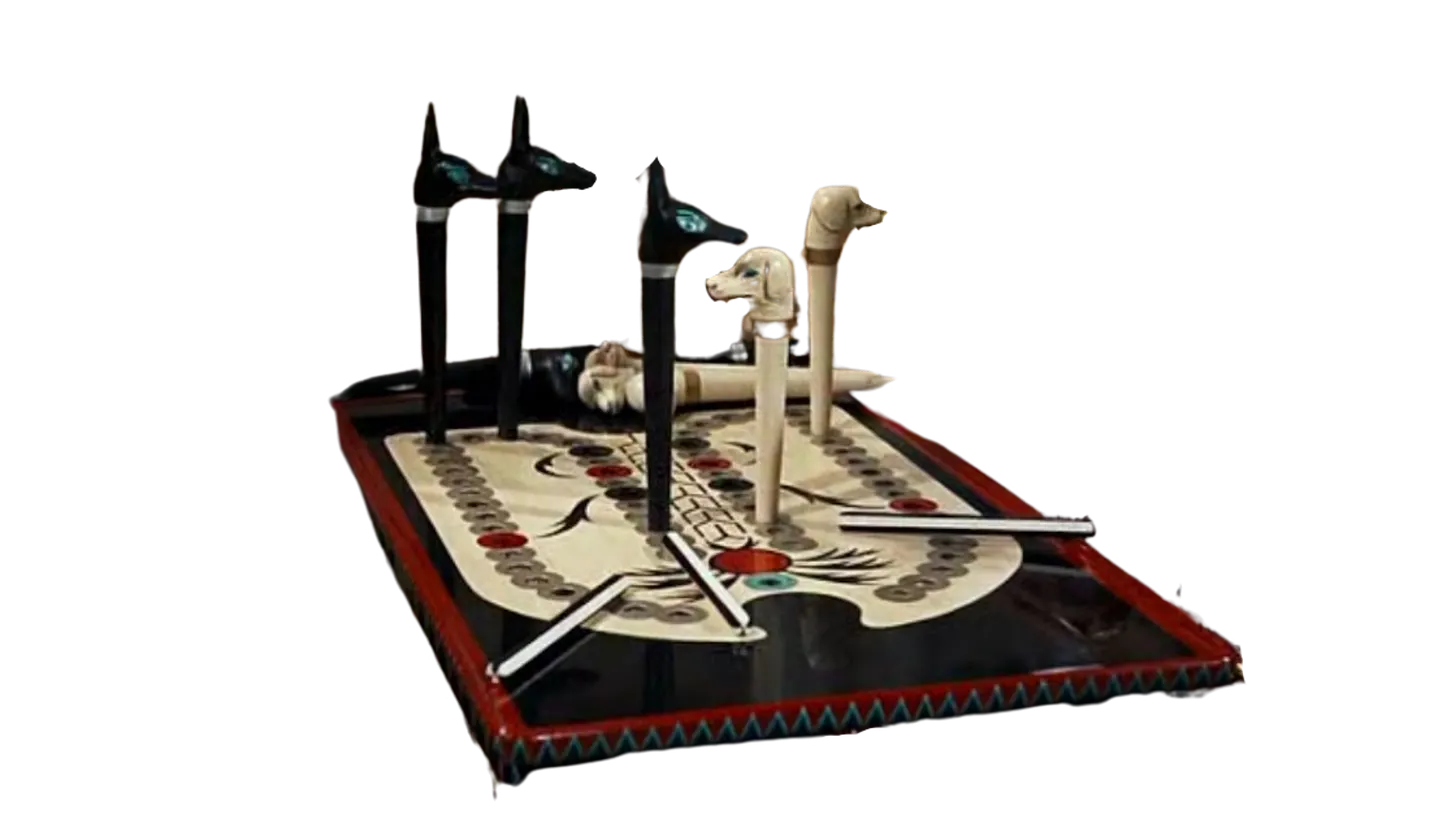
Two images run through everything this house makes and every document it writes. A hound. A jackal. There are also two others that appear frequently. A human being. A fire. Hounds & Jackals loves the number four. These four symbols turn up frequently and until now nobody had written down what they mean, so a new reader met them as decoration.
This is the explanation.
Why these animals
Because the best experiences do two jobs at once.
They keep you company. They also take you somewhere you would not go on your own.
A dog does both. It sleeps at your feet and it goes first into the dark. That is the whole reason the name is what it is, and everything below is the long version.
What the symbols mean
The hound
The hound is the companion.
Dogs have lived alongside people for something like ten to fifteen thousand years, which is longer than farming, longer than writing, longer than anything we call civilisation. Whether we domesticated them or they domesticated us is still argued. Either way, they were there first.
What the hound stands for here is a particular way of being in the world. A dog leads with its nose rather than its eyes. It works in what is happening now rather than in what it remembers. Its loyalty is not a decision it makes each morning; it is how the animal is built.
Three things follow, and they turn up all over the house.
The nose knows first. Taste means a sense and taste means a judgement, and a dog has never separated the two. This is where the house guidance on creative direction comes from, which is set out in Taste, Not Style.
Being in a thing beats explaining it. A dog does not need the world accounted for before it can enjoy being in it. So the horror scenario does not name what the monster was, and the card deck uses natural archetypes, because nature does not explain itself either.
Staying. The hound is the one who is still there in the morning. That is why collaborators here are named rather than absorbed, and why the same illustrators and musicians come back across projects instead of being hired once.
The jackal
The jackal is the other half of the name, and it is not a lesser dog.
Jackals were never tamed. They live where a town ends and the fields begin, close enough to eat well and never close enough to be let indoors. In Egypt, jackals dug up shallow graves, so the Egyptians made a jackal the god who guards the dead. Anubis is a scavenger promoted to sentry.
So the jackal stands for the far edge of what people have settled. The dark part of the work. Horror, dread, the ending that stays open, the scenario that asks a table to sit with something uncomfortable. This house makes a great deal of that, and it is the same animal doing a different job.
One animal, not two
The easy reading is that these are opposites in balance. That reading is wrong, and the truth is better.
Hounds and jackals are the same animal. Both are canids, closely enough related that a golden jackal and a domestic dog can breed and produce fertile pups. One family went two ways. One came in to the fire and one stayed out at the treeline.
Neither is purely what it looks like, either. A hound is still a predator; the spaniel on your sofa is built to catch things and kill them. Jackals mate for life and raise their pups together, which is to say they are devoted to their own.
So when a book here is warm and has something terrible underneath it, or frightening and turns out to be about love, that is the animal being what it is.
The human
The third symbol, and the easiest to miss, because it is the one doing the looking.
Everything above is defined by a relationship to people. The hound came to a fire that people had built. The jackal waits at the edge of towns that people made. The motto is for the play and imagination of being human, not of being a dog.
And in the game the name comes from, the hounds and jackals are the playing pieces. The person is the player. The animals get moved around the board. The human is the one having the experience, and the experience is the entire point.
Which is why a game needs somebody at the table, an album needs somebody listening, and a bar that does not exist needs somebody to walk into it. Everything here is unfinished until a person arrives.
The game
Hounds and Jackals is also a real board game, and one of the oldest anybody has found.
It was played in Egypt around four thousand years ago on a board pierced with holes, using pegs with heads carved as hounds and jackals. Two players, a race, chance and a route.
Complete sets have been dug out of royal tombs, packed alongside food, jewellery and weapons. That detail is the one that matters. These people were equipping somebody for eternity, and they included a game.
Play was not something to be put aside when serious matters came up. It was part of the kit for existence. That is the oldest argument for what this house believes, and somebody else made it four thousand years ago.
One more thing the game gives us. On the board, the hounds and the jackals are opponents. In the name, they are partners. Both are true and the house leaves it that way.
The fire
The fire is the oldest meeting place there is. People have sat around one in the dark, telling each other things, for as long as there have been people. It is where stories were kept before anybody wrote anything down.
Here it means three things.
The gathering. The people around it: collaborators, readers, players, anybody who has taken part. When a document says the fire is lit and you were expected, it means a chair was kept for you before you arrived.
The light. A fire lights a small circle and the dark starts a few feet away. That is the honest shape of the work: warmth, with something unresolved just outside it. The hound sits in the circle. The jackal is out where it ends.
The test. A fire is also where a thing gets worked and tried. The Firekeeper’s Guide asks the last questions before anything leaves, and they come down to whether it is good enough to hand to the people sitting there.
What happens to work that does not deserve a place
It goes back to the bench. Nothing here gets destroyed or abandoned, and the bench has a document of its own, which is how a thing gets made and remade.
Ideas go into storage instead, sometimes for years, until whatever was missing turns up. Nothing that fails here is finished with.
Shepherds
There is one more job the hound and the jackal do, and it was in the work long before anybody wrote it down here.
Dogs guide the dead. That is what the myths actually say, and one of the card decks this house makes, the Mythodogical Deck, was built on it. Xolotl walks the sun through the underworld each night. Anubis weighs the heart and leads the person across. Hecate carries the keys to the gates between worlds. Yama’s two hounds guard the road the dead travel. Four cultures, one job.
So the hound and the jackal walk you into the part you would not enter alone, and they walk you back out.
That is what a work here is built to make possible. A horror scenario takes four people somewhere frightening for three hours and builds the way back to the kitchen table into the work itself. A bar that does not exist takes a reader somewhere for an evening and leaves the door open behind them. The crossing is the thing, and the animal at the door goes with you.
How a symbol earns its place
Nothing above was chosen because it looked good. That is the rule, and it is an easy one to break.
The surface has to be plain. A hound is a dog. A fire is a fire. Nobody should need a glossary to know what they are looking at.
Underneath it there has to be a real reason. Something that connects to what this house believes, and that you could say out loud if somebody asked. The jackal is in the name because a jackal lives at the edge of a settlement, neither tame nor wild, and a great deal of what this house makes is about that in-between place.
Surface with nothing underneath is decoration, and decoration gets cut.
The test is uncomfortable on purpose. Can you say why it is there without inventing the reason afterwards?
A failure, for the record
Until recently some of these documents were divided by a small ankh. Nobody chose it. It was copied from one file into another because it looked right, then repeated until it appeared to be a house mark.
Put the test question to it and there is no answer. An ankh means life, and nobody had thought about whether this house was claiming that. It had a surface and nothing underneath, so it went.
The same rule for objects
This governs the things the house makes, not only its marks.
A card deck is a card deck. You can shuffle it, deal it, and play a hand of poker, and it should work perfectly well if that is all anybody ever does with it. Underneath, the four suits carry four deities and four ideas about living well, so the same deck can be used for a reading. Both layers are real and the second one is never announced on the box.
Yin and yang
Yin and yang says the same thing as the hound and the jackal: two things that look like opposites, each carrying part of the other.
The house already uses it. The Mythodogical Deck maps each suit to one of the four ideas about living well, and the deck back arranges the four deities into the shape of the symbol: Anubis black, Xolotl black with a white skull mask, Hecate white with black spots, Bau white.
For those who work with the House, The Use of the Symbols is for anyone actually putting one into a book, an album, a show or a mark: how they take form as characters, what the monogram is, and how sparingly to spend them.