Taste, Not Style
On casting the right hand (or paw)
This one assumes you have already read Who We Are, the symbols, and the Manifesto at least. Without those, this will read as procedure rather than as the reason for the procedure.
This document holds the judgement. Why the house works this way at all is the Manifesto’s question, and the section called Many Hands is where it answers.
The distinction
This house does not have a house style. It has a house taste, and the difference between those two things is most of what I believe about making anything.
A house style is one look, one sound, one voice that every work gets bent toward. It reassures at first and it flattens over time, and the larger it grows the more generic it becomes, because consistency of appearance is the easiest kind of consistency to manufacture and the least worth having.
A house taste is the right hand, chosen with intent, for the work in front of it.
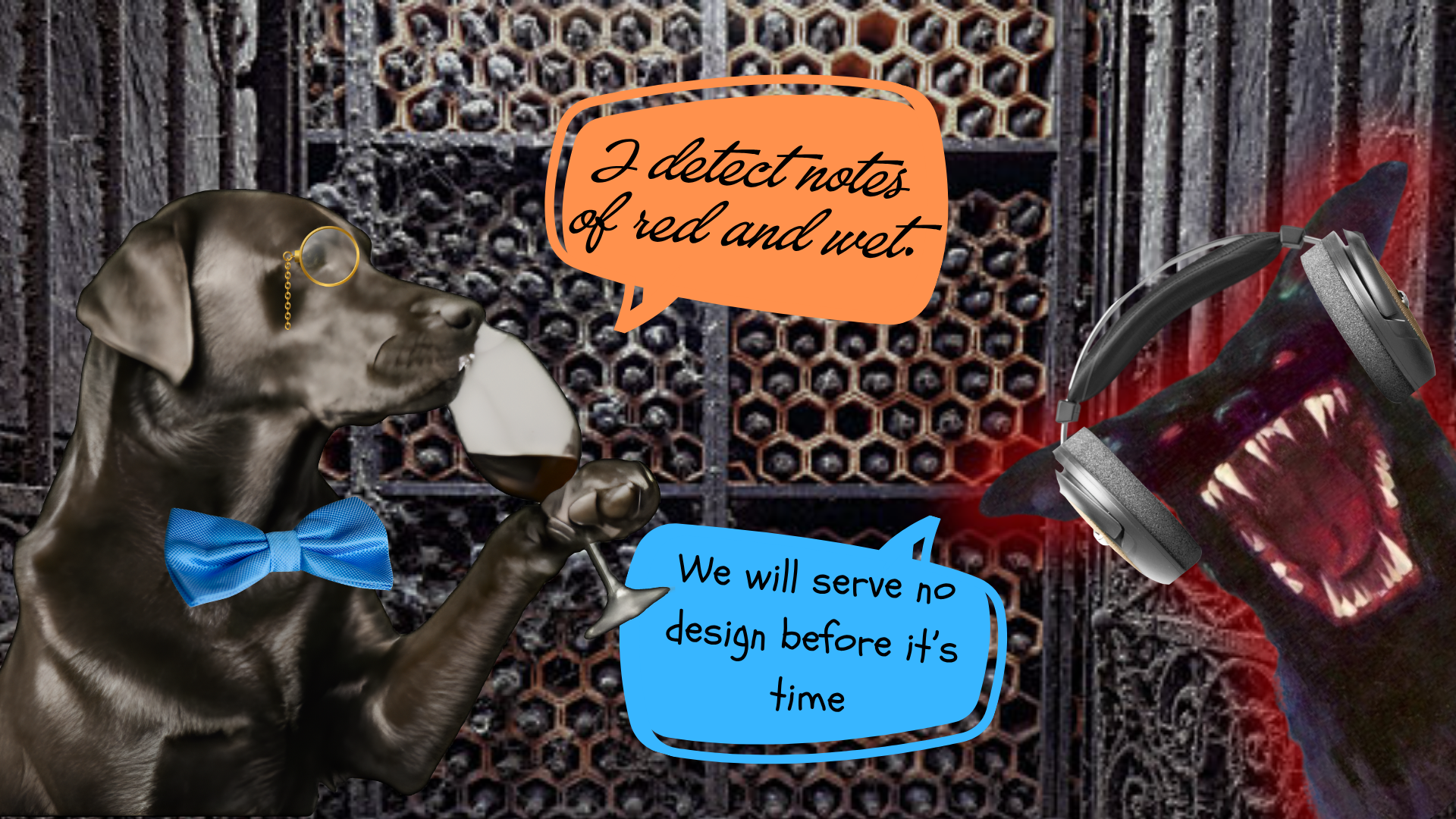
There is a reason a house of hounds trusts taste over style, and it is in the word itself. Taste is a sense, the kind you smell and eat with. Taste is also judgement, knowing what is good. A dog has never separated the two. Style belongs to the eye. The nose is harder to fool.
What a house style actually costs
Picture a house with one look. A strong flat outline, simplified figures, a fixed palette, cheerful weight. It is applied to everything the house publishes, and it is applied well.
Three books come out. A superhero book, a gothic horror, and something cosmic and enormous. Nothing is badly drawn. Every page is competent, consistent, and recognisable from across a shop.
The superhero book is excellent. The look happened to be right for it.
The gothic horror cannot be as dreadful as it could have been, because dread lives in what a line refuses to show and this line shows everything at the same volume. The cosmic book cannot be as vast as it might have been, because a style built for warmth has no register for indifference. Two of the three books can never quite become the thing they were trying to be, and no individual decision was wrong. The narrowing happened once, permanently, before any of those books existed.
None of them is ugly, and none of them fails. A book made to put dread into somebody can still do it through the writing and the pacing, even when the pictures are cheerful. But a reader meets all of it at once, and every part is telling them what kind of thing this is. When one part says something different, or arrives at a different intensity, they notice.
Sometimes that is exactly the intent. Children singing during a horror sequence works precisely because it does not match, and a scene can be built on the mismatch. But that dissonance was chosen, and a house style is dissonance nobody chose. The distinction is the whole difference between a decision and a default.
Once somebody is noticing an incongruity that was not put there on purpose, they are no longer inside the story. The book spends part of its strength fighting itself instead of doing what it was made for.
And it does not happen just once. It happens again with everything published afterwards, until, over the years, you have a body of work that is competent, but never quite becomes what it could have been.
The same failure, one book at a time
It happens locally too, and it is harder to spot because the work comes back good.
A hand that draws like memory and archive gives you a scenario about reconstructing the past exactly as it should feel: half remembered, edges soft, the record incomplete. Give that same hand a story about reading the evidence of a vanished world and it comes back warm, and warmth is the wrong feeling for a page that should read like inscription cut into stone by somebody who is gone.
Swap them and the failure reverses. The inscribing hand renders the memory piece accurately and airlessly, and accuracy was never what that book needed.
Neither hand is worse than the other. Both are wrong for one of those jobs, and a fixed house look would have locked one of those errors in and called it consistency.
What the house is actually casting for
A capability is something a person built in themselves over years. It does not come off a shelf like a flavour, and casting means recognising what somebody has built, then matching it to a work that needs exactly that.
A voice that can hold a clean line across a hall did not arrive able to do it. Neither did a voice that can tear and keep tearing all night without wrecking the instrument, which is a technique with a great deal of discipline underneath a sound that appears to have none. One of those voices will carry a lament that has to stay dignified. The other will carry a song about something monstrous that is also grieving. Give each the other’s job and both of them will sound like a mistake.
The same is true of a layout hand who knows when to leave a page nearly empty, and of a composer who can write something that stays wrong-footed for four minutes without becoming unpleasant. Every one of those is earned, every one is specific, and most of them took a decade to build.
The mixing
Casting one hand well is the easy half. The work is usually three or four hands at once, and they do not add up. They combine.
A heavy dark line, a clean high voice, and a layout that leaves air around everything can produce something none of the three contains on its own. The same three components arranged badly produce a muddle where each element is fighting the others for the same job. What decides which of those you get is not the quality of the individual hands. It is whether somebody was holding the whole thing in mind while choosing them.
That is the judgement, and it is why this document runs alongside the whole length of a build rather than sitting at the front of it. Taste chooses the hand, then looks at what comes back and asks whether the match actually held, then answers again at the end, when the question is whether the finished thing should go out at all.
And that last answer has to be allowed to be no. If a work cannot find a hand that will do it justice, it does not get published. It waits. A house that will not withhold a finished thing has taste as an opinion rather than as a standard, because the only proof the judgement is real is that it is occasionally expensive.
Three layers, kept apart
Most houses collapse these into one and then wonder why the work all sounds alike.
The voice belongs to the maker. The artist, the composer, the writer, the performer. It varies by person and it is theirs.
The grammar belongs to the work. The signature devices chosen for it, a technique, a motif, a recurring move, the things that hold one work together across any hand. It varies by work.
The taste belongs to the house. The judgement that casts a voice against a work and knows when the match is true. It is the only one of the three that stays.
The hand serves the work, never the house
The work decides what it needs. Gothic quiet, cosmic scale, heroic pulp, restrained dread, a score, a rules system, a single trick.
In theatrical magic the first law is that the method serves the effect. What the audience feels decides how the thing is built, and never the reverse, and a clever method in search of an effect makes hollow magic every time. This house runs on the same law.
The match is a kind of honesty. A work dressed in a house uniform tells its audience a small untruth about what it is. A work given its right hand tells them the truth, and they feel it before they can name it.
Somebody who recognises a hand and expects a particular weather from it is not finding a crack in the brand. They are meeting it. Nobody should ever think every work from this house looks the same. They should think each one looks and sounds and reads exactly like the thing it ought to be.
Style, age, and what lasts
A style built to match its moment dates with its moment. A style built because it was right for the thing outlasts it, and often outlasts the moment by a long way.
The difference is what the choice was answering to. Fashion answers to the room. Taste answers to the work. And the difficulty is that you usually cannot tell which one you were doing until the moment has passed, which is an argument for making the choice against the thing in front of you rather than against what is currently admired.
Two standing cautions
A voice known for one thing is a gift to the audience and a cage to the maker. The signal that says of course, this is who drew it, can harden into a wall the maker cannot climb. Leave a door in it. The same freedom the house keeps for itself, to choose the right hand every time, it owes to the maker, to step out of the lane the house drew for them. The hand that surprises us out of its lane is often the one that makes the thing we remember.
And the larger one. The strength of this house is also its dependency. The taste is the single constant, which makes it the single point of failure. Guard it. Cultivate more than one keeper of it. Write it down, so that one day it can be handed on rather than lost with whoever held it.
The taste is the asset. The briefs, the working files, the habit of naming the register before anything else: none of those is it. They are only how it travels.
A style can be copied. A taste has to be acquired.
The Bench is how a thing is then actually built, first question to threshold, with this judgement running alongside the whole way.
Where this document ends
This governs who a work is given to, and how that hand is pointed at the work rather than at a house look. The Bench governs how the thing is then made. The Pact of the Pack governs how the house behaves toward the person once they are working. These three meet at every commission and should never be confused. One decides whom the house casts, one decides how the work is built, and one decides how the house treats the person building it.