The Use of the Symbols
Putting a hound, a jackal, a human or a fire into something the house makes

This one assumes you have read The Hound, the Jackal, and the Fire, which says what the four images mean and why they are the ones. That document is the meaning. This is the use, and a reader who is not making something does not need it.
How the symbols take form
The symbols turn up as characters. There are three levels of that and they are not the same thing.
The symbols themselves. Hound, jackal, human, fire. They belong to no project and no book owns them.
The embodiments. A symbol given a name and a job, carrying its nature with it. The Sound Hound tracks by ear, which is a hound tracking by nose in another sense. The Jackal of All Trades ranges across territory and makes use of whatever is there, which is what jackals do. These cross projects, because the symbols do.
The project personas. Characters cast for one work because that work asked for them, the same way an illustrator is cast. Dino Martini hosts a kaiju lounge with a nod to Dean Martin. Dr Spektor hosts bizarre magic, built out of Rod Serling and named for Adam Spektor. They answer to the work, and they carry no hound or jackal nature at all.
The rule that tells the second from the third: an embodiment has to carry the nature of the symbol it came from. A hound persona tracks something. A jackal persona crosses an edge. Anything else is a project persona and should be treated as one.
The mark
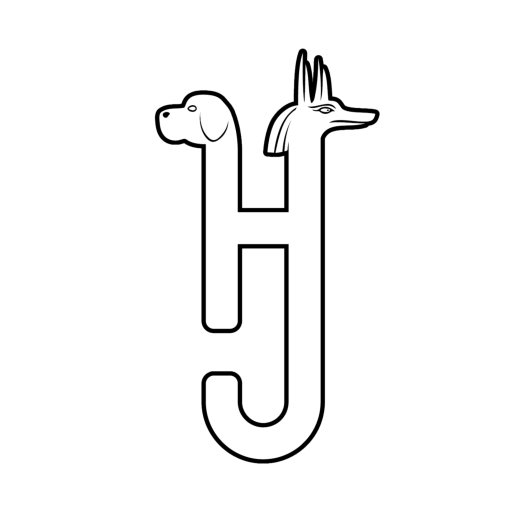
The monogram is built on a hound’s head, with Anubis standing beside it. Both animals, present at once, which is the whole idea in a logo.
Using the symbols
Any document may use the hound, the jackal, the human or the fire without explaining them, and should point at The Hound, the Jackal, and the Fire instead of explaining them again. That document is where they are explained, and it does not point back at everything that uses them.
Public work should use them sparingly. Somebody who meets the fire in a newsletter, a book and a product page in the same week will stop seeing it, and a symbol nobody sees is decoration again.
The marks on the website
The four cover marks of the Books of Honest Wonder are also used on the site, and they carry one rule there. The ring marks a door. Whatever sits inside the ring says where the door goes: an empty exhibit case on Cynopolis, an archaeologist dog on Works. The mark is the constant and the contents vary.
A ring that leads nowhere is decoration and gets cut, by the same test as everything else here. And because blue means this leads somewhere else across the whole site, a ring that is a door carries the blue and answers to a hover.
The ladder and the spiral are not spent yet. If either is ever put on the site it needs a meaning of its own, arrived at the same way: something you could say out loud if somebody asked.
Where this document ends
This governs putting a symbol into a thing. What the symbols mean, and the test a symbol has to pass before it earns its place at all, is The Hound, the Jackal, and the Fire. How a work is matched to the hand that should make it is Taste, Not Style.